A chip that finds a rhythm with light
Q.ANT demonstrated a Fourier transform on a photonic processor. Four microphone samples reveal what that operation hears and what a stopwatch can miss.
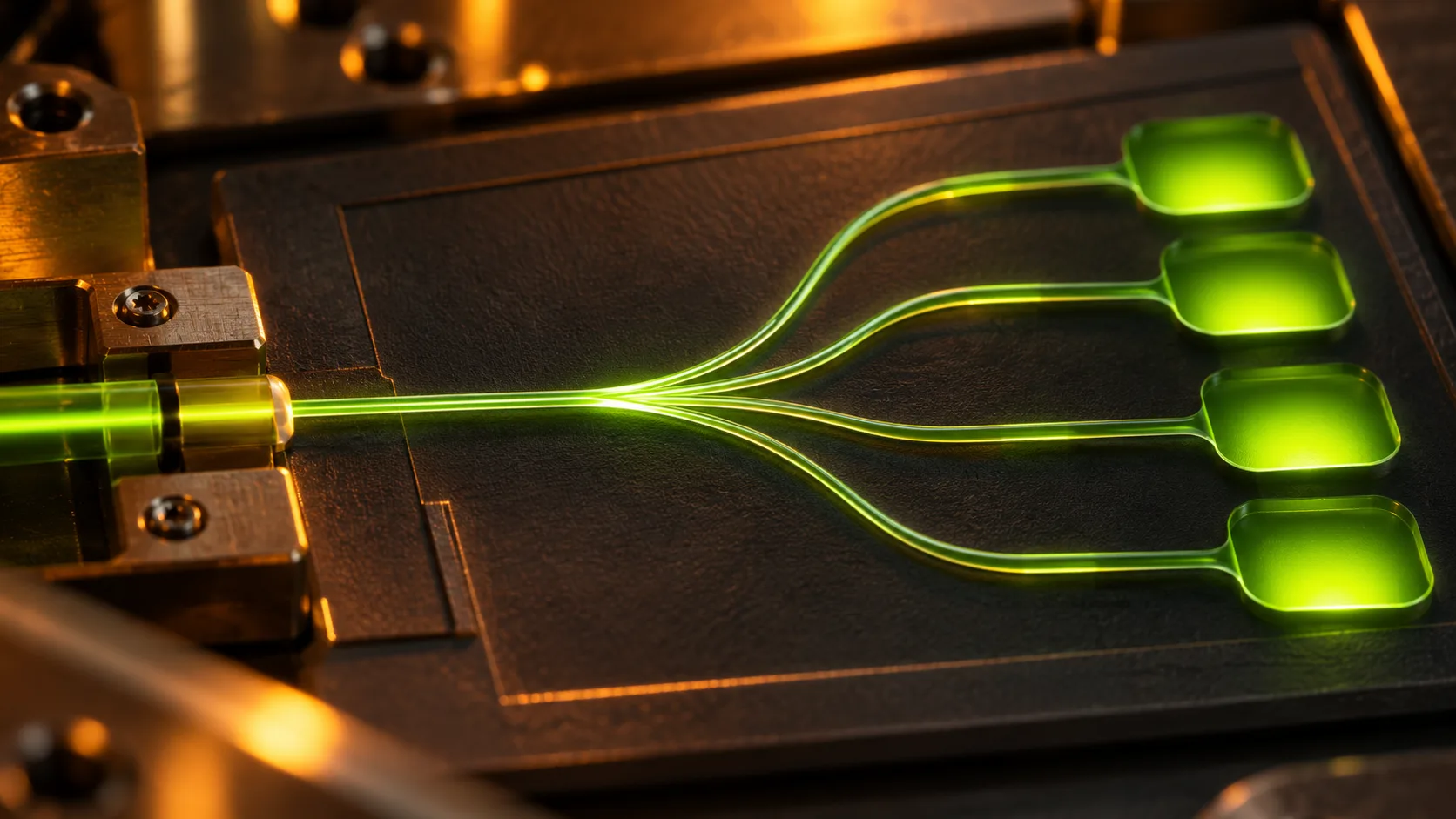
Listen to four numbers
A microphone on a workshop bench records a fan starting up. You can hear the pitch climb. All the computer has is a long column of numbers, each one recording where the microphone signal stood at a particular instant. Where, exactly, is the note hiding in that column? This week a computing company took an operation that helps answer that question and demonstrated it on a chip that calculates with light.
On 17 November at SC26, Q.ANT announced a photonic processor that performs a discrete Fourier transform. The company demonstrated its NPU Gen 2+ alongside an AMD GPU in a hybrid language model workload. The striking detail for a programmer is the choice of operation. Fourier transforms already have a precise mathematical meaning. That gives us a way to ask what a radically different piece of hardware actually computed.
Source: Q.ANT announcement
A rhythm you can check by hand
Take four imaginary microphone samples, recorded at equal intervals. The first set reads 1, 0, -1, 0. A second set reads 1, -1, 1, -1. Both average to zero. Yet if you tap them out, treating positive as a high tap and negative as a low tap, the second pattern alternates at every step. Averaging has discarded the very thing you wanted to hear. A transform compares each set with a collection of reference rhythms and reports how strongly each rhythm matches.
For the four samples in our first set, imagine laying a transparent strip marked with exactly one cosine cycle over the numbers. Its crests and troughs line up. Lay that same strip over the second set and the agreement disappears. A strip with two cycles now lines up instead. The actual calculation uses sine as well as cosine, which lets it represent a pattern whose crest falls somewhere else. Our four samples are a teaching example small enough to inspect with a pencil.
What should a stopwatch include?
Suppose you are choosing a processor for a recorder that has to flag an odd vibration before the next batch of samples arrives. You already have a reference transform running on a laptop. Write down the time when a batch becomes available and the time when the flag becomes visible to the person watching the machine. Between those two moments the program may copy data, wait for enough samples, submit work, receive its result and look for a peak. A fast operation changes only part of that interval.
There is a second check worth making before comparing times. Feed both systems the same quiet recording, a single clear tone and a tone close to the boundary between two frequency bins. Compare the numerical outputs within a tolerance you declare in advance. Then compare the decision the recorder would actually make. Two answers can differ slightly and still flag the same vibration. A tiny discrepancy near the alarm threshold deserves closer attention.
Start with the signal you recognize
A demonstration tells us an operation can participate in a larger computation. The recorder raises a more personal question. Would putting that operation somewhere else help this particular listener hear something sooner? Keep the four numbers as your first test case. When a new device, library or optimization comes along, you already know which rhythm ought to come back.